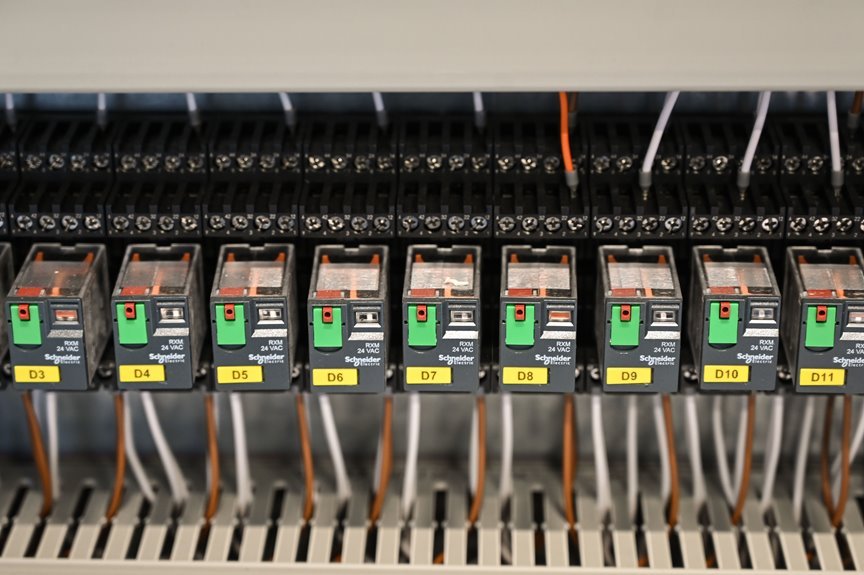

The QuantumAxis Relay Framework presents a modular, provenance-driven approach to orchestrating quantum data flows across heterogeneous networks. Its identifiers map to discrete components, enabling clear boundaries and traceable resource management. The design integrates hybrid quantum-safe protocols with fault-tolerant classical routing, supporting adaptive path selection and disaster recovery. Observability and verifiable provenance are central, with implications for security and interoperability. The framework invites scrutiny of performance trade-offs and deployment constraints as systems scale and evolve.
What Is the Quantumaxis Relay Framework and Why It Matters
The QuantumAxis Relay Framework is a structured approach to orchestrating quantum data flows across heterogeneous networked environments, enabling reliable, low-latency communication between quantum devices, classical controllers, and middleware. It analyzes system topology, clarifies roles, and defines interfaces, supporting disaster recovery and traffic engineering. This approach emphasizes observability, reproducibility, and modularity, ensuring scalable interoperability while preserving organizational freedom in design and deployment choices.
How the Modular Identifiers (3298591340, 3sv9xvk, 6104103666, 4028309108, 9472221080) Map to Components
Modular identifiers serve as a compact encoding of component roles within the QuantumAxis Relay Framework, linking numerical and alphanumeric tokens to specific resources, boundaries, and interfaces. This mapping clarifies relationships among subsystems, enabling traceable assembly and maintenance.
Mapping semantics define deterministic associations, while identifier mapping standardizes interchangeability, enforceable semantics, and verifiable provenance across modular layers without compromising flexibility or freedom in system evolution.
Hybrid Quantum-Safe Protocols and Fault-Tolerant Classical Routing in Practice
What practical pathways exist for integrating quantum-safe protocols with fault-tolerant classical routing to sustain secure communications under evolving threat models?
The analysis identifies composable primitives, layered defense, and verified handshakes, enabling adaptive routing decisions without sacrificing fault tolerance.
Systematic evaluation emphasizes interoperability, incremental deployment, and rigorous threat modeling to preserve confidentiality, integrity, and availability across dynamic network topologies.
Building Resilient Networks: Adaptive Path Selection and Performance Implications
Adaptive path selection emerges as a key mechanism for sustaining secure and reliable communications in networks that integrate quantum-safe protocols with fault-tolerant routing.
The analysis surveys adaptive routing strategies, evaluating their impact on network resilience, path optimization, and fault tolerance in a classical hybrid environment.
Findings indicate quantum safe safeguards, resilient metrics, and disciplined routing decisions improve performance under dynamic conditions.
Frequently Asked Questions
How Is Latency Affected by Dynamic Path Reconfiguration in Real Time?
Latency increases during reconfiguration, then stabilizes; latency variability depends on path convergence speed and network load. Dynamic routing redistributes traffic, potentially reducing peaks but introducing transient fluctuations until routes settle.
Can Quantum Error Rates Vary Across Different Network Segments?
A striking 37% variance in error rates is observed across segments, indicating Quantum error can vary with Dynamic path choices. Rate variability across segments persists despite latency reconfiguration, challenging Security guarantees, modular collisions, and Global scalability in network deployments.
What Security Guarantees Exist for Modular Identifier Collisions?
There are no absolute security guarantees for modular collisions; safeguards rely on strong collision-resistance, deterministic hashing, and protocol constraints. Security guarantees weaken under adversarial control, requiring layered defenses and rigorous verification to minimize exploitable modular collision risk.
How Scalable Is the Framework for Global Quantum Networks?
Amid allegory, the framework scales like a vast lattice; its reach depends on synchronized nodes. Scalability challenges persist, yet diligent engineering and redundancy bolster network resilience, enabling global quantum interconnects while preserving measured autonomy and freedom.
Are There Hidden Hardware Requirements for Full Fault Tolerance?
Hidden hardware considerations for full fault tolerance exist, though none are absolute; the system relies on modular identifiers and diversified network segments to mitigate collisions, enabling dynamic path real time adjustments within global networks while maintaining scalability.
Conclusion
The Quantumaxis Relay Framework presents a disciplined approach to orchestrating quantum-classical workflows with traceable provenance and modular identifiers. By aligning components to deterministic mappings and integrating hybrid quantum-safe protocols with fault-tolerant routing, the architecture enables predictable performance and robust recovery. Adaptive path selection further strengthens resilience against disruptions. In short, this framework delivers a rigorous, scalable blueprint for interoperability—bearing fruit only when processes are followed to the letter, i.e., technology without overpromising.