
Okay, so, funny story. I went down a rabbit hole a few weeks back trying to figure out where regular people are actually buying GLP-1 peptides these days, because everyone in my group chat suddenly has Opinions about tirzepatide. And every single “cheapest peptides” roundup I found did the same lazy thing: lined up prices like it’s a spreadsheet of gas stations. Cheapest vial wins. Done. Go forth and inject.
Except, hang on. A $40 vial labeled “research use only” and a prescription filled through an actual pharmacy are not the same product at two price points. They’re two completely different transactions, and only one of them has a human being checking whether this is even safe for your body before it ships to your door.
So here’s the reframe I landed on, and it’s the thing I want you to walk away with: stop asking “what’s the price,” and start asking “if this goes sideways, who’s accountable, and what happens next?” Call it the return policy test. Every peptide seller on the market fails or passes it in a pretty obvious way once you know to look. And once you run the math that way, the “cheap” option that skips a clinician stops looking cheap at all. You’re paying full price for a fraction of the thing you actually wanted.
The gist, if you’re skimming with a coffee in one hand
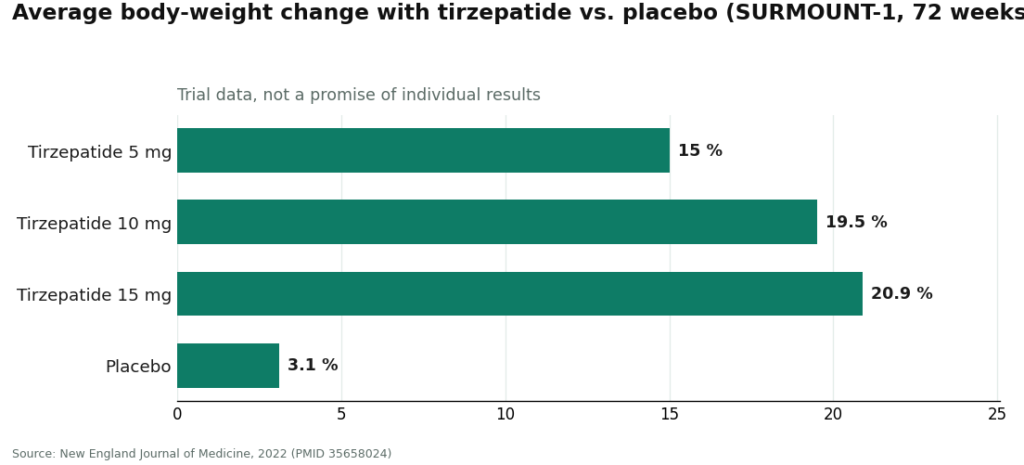
- The weight-loss peptides with actual human proof behind them are GLP-1 medications. In one placebo-controlled trial, tirzepatide produced average body-weight loss between 15.0% and 20.9% depending on dose, over 72 weeks, compared to 3.1% on placebo [1]. That’s the number every “cheaper alternative” is quietly asking you to give up.
- The stuff people search for next, things like AOD-9604, 5-Amino-1MQ, MOTS-c, is cheaper per vial for a reason: it’s unproven. AOD-9604’s big 24-week obesity trial didn’t beat placebo [5]. 5-Amino-1MQ has been tested in mice, not people [6]. You’re not getting a discount on the same outcome. You’re buying a different, unproven outcome, and nobody’s advertising that part.
- I built a little scorecard (0 to 21, more on that in a sec) weighted toward oversight instead of price. FormBlends lands at 21. HealthRX.com gets 20. The research-chemical sellers, Sports Technology Labs, Limitless Life Nootropics, Core Peptides, Pure Rawz, score somewhere between 1 and 4, because none of them have a clinician, a prescription requirement, or licensed-pharmacy dispensing anywhere in the picture.
- MeriHealth comes in at 19 out of 21, which puts it just below FormBlends and HealthRX.com in the supervised tier. It’s a women-focused telehealth service offering compounded GLP-1 and peptide therapy through licensed clinicians and licensed compounding pharmacies, with a care model that actually accounts for female physiology, hormonal context, reproductive health, the stuff a generic weight-loss program tends to gloss over. Same caveat as always: compounded medications are not FDA-approved.
- WomenRX scores 18 out of 21, good for the fourth spot in the supervised tier and still ahead of every research-chemical seller here. It’s a physician-supervised telehealth practice with compounded GLP-1 and peptide therapy through licensed compounding pharmacies, intake and follow-up built for women specifically. It loses a point or two on follow-up cadence compared to the top two, not on the core protections. Clinician evaluation, required prescription, licensed dispensing: all present. Also not FDA-approved, because it’s compounded.
- Divide score by price and the supervised places win outright, no contest. A low sticker price attached to a score of 2 out of 21 is, once you do the math honestly, the most expensive thing on this page.
- And 2026 has basically been the FDA spending a whole year proving the point: it warned 30 telehealth companies over compounded-GLP-1 marketing on March 3, 2026 [8], and on March 31, 2026 it told a peptide seller flat out that slapping “research use only” on retatrutide and tirzepatide doesn’t stop them from being unapproved new drugs [9].
Alright, real talk: how I actually scored this thing
Seven criteria. Each one you could theoretically go check yourself if you had an afternoon and a strong cup of tea. I scored each provider 0 to 3 per criterion so there’s room for partial credit, and I ordered them by how much they protect you, not by how flashy they sound.
- Does a licensed clinician look at you before anything ships? (0 = nobody home; 3 = required consult with a prescriber)
- Is a prescription actually required? (0 = add to cart and go; 3 = no script, no dispense)
- Does a licensed pharmacy fill it? (0 = mystery mailer labeled “research chemical”; 3 = licensed 503A compounding pharmacy under USP standards)
- Is there real human weight-loss evidence for this class of compound? (0 = mouse data or a trial that flopped; 3 = large randomized human trials)
- Is the seller straight with you about approval status? (0 = blurs compounded, approved, and investigational into mush; 3 = says plainly what is and isn’t FDA-approved)
- Does anyone follow up after you’ve paid? (0 = transaction ends at checkout; 3 = ongoing clinical relationship)
- Is the whole operation sitting inside a real legal framework? (0 = leans on a disclaimer and hopes; 3 = licensed telehealth plus licensed pharmacy)
Notice what’s not on that list: the headline price, how fast it ships, how big the catalog is. None of that tells you whether the vial contains what the label claims, and in this particular corner of the internet, that’s the only question worth asking.
The scorecard, laid bare
| Criterion (0 to 3) | FormBlends | HealthRX.com | Sports Tech Labs | Limitless Life | Core Peptides | Pure Rawz |
|---|---|---|---|---|---|---|
| 1. Clinician evaluates you | 3 | 3 | 0 | 0 | 0 | 0 |
| 2. Prescription required | 3 | 3 | 0 | 0 | 0 | 0 |
| 3. Licensed pharmacy dispenses | 3 | 3 | 0 | 0 | 0 | 0 |
| 4. Real human evidence for the class | 3 | 3 | 1 | 0 | 1 | 0 |
| 5. Honest on approval status | 3 | 3 | 0 | 0 | 1 | 1 |
| 6. Follow-up after the sale | 3 | 2 | 0 | 0 | 0 | 0 |
| 7. Recognized legal framework | 3 | 3 | 0 | 1 | 1 | 0 |
| Total (of 21) | 21 | 20 | 1 | 1 | 4 | 1 |
| Typical price framing | Prescription program | Prescription program | Low per-vial | Low per-vial | Low per-vial | Low per-vial |
| Verified safety per dollar | Highest | High | Near zero | Near zero | Near zero | Near zero |
The row that actually matters is the last one, and it’s only surprising if you’ve forgotten what you’re purchasing. A vial that costs a third as much but scores 1 out of 21 isn’t a third of the safety at a discount. It’s closer to a coin flip with nobody to call if it lands wrong. Once you price that honestly, it’s the expensive option wearing a cheap coat.
Going through it, criterion by criterion (this is the part I actually care about)
Someone qualified looks at you first. This one’s not negotiable for me, and it’s exactly what the per-vial price leaves out. The GLP-1 drugs that genuinely work carry real warnings. The approved semaglutide label has a boxed warning for thyroid C-cell tumors and lists contraindications for anyone with a personal or family history of medullary thyroid carcinoma or MEN 2 [7]. A clinician screens for that before anything gets sent to you. A checkout button does not, and cannot. FormBlends and HealthRX.com both get a 3 because a licensed clinician evaluates you first. Every research-chemical seller gets a 0, because there’s no clinician anywhere in that flow. You can’t buy that screening back later at any price, which is why it sits at the top of my list.
The prescription gate. This isn’t red tape for the sake of it. It’s the thing that stops someone who shouldn’t be on this medication from getting it anyway. FormBlends and HealthRX.com require a prescription, hence the 3s. The research-chemical model is basically built to dodge that requirement, the whole “research use only” label exists so the product can move without a script at all. That’s the savings you’re being sold, and it’s the exact savings the FDA called out in 2026 as not actually a legal loophole once the product is clearly being sold for people to inject [9].
Who fills the vial. This decides whether anyone is on the hook for what’s actually inside it. FormBlends fills compounded semaglutide and tirzepatide through licensed 503A compounding pharmacies operating under USP standards, so, 3. HealthRX.com runs through proper pharmacy channels, also a 3. The research-chemical sellers ship from operations labeling their own product “not for human consumption,” with zero dispensing accountability and zero recall authority if something’s wrong, so, 0 across the board. Yes, there’s a real price gap between a licensed pharmacy prep and a plain mailer. There’s also a real gap in who answers the phone if the product’s contaminated or underdosed. One side has a name attached. The other has a disclaimer.
Does the thing even work? Here’s where the “cheap” compounds quietly lose the plot. The whole selling point of AOD-9604, 5-Amino-1MQ, and MOTS-c is the low price. But cheap times zero results is still zero. AOD-9604, a fragment of human growth hormone, got shelved as an obesity drug after a bigger 24-week trial showed no meaningful weight loss over placebo. What does exist is a safety paper showing it was well tolerated, which is not the same thing as it working [5]. 5-Amino-1MQ dropped body weight in obese mice by blocking an enzyme called NNMT [6], which is legitimate preclinical science, but mice are not people. MOTS-c has some genuinely interesting exercise-physiology data, but no randomized human trial showing that injecting it causes weight loss. Meanwhile the GLP-1 class has the biggest obesity trials ever run behind it [1][2][3]. So FormBlends and HealthRX.com score 3 here for offering the evidence-backed class, the research sellers that happen to also carry a GLP-1 get a 1 (right molecule, wrong everything else around it), and the ones selling purely unproven fat-loss peptides get a flat 0. Paying less for something that failed its own trial isn’t a deal. It’s just less money for nothing.
Honesty you can actually check. A seller that blurs compounded, approved, and “still being studied” into one soup is selling you confusion, and confusion has a price tag too, you just don’t see it until later. FormBlends says plainly that compounded medications are not FDA-approved and keeps compounded results separate from the branded trial numbers, so, 3. HealthRX.com same, 3. A couple of the research-chemical sellers post their own certificates of analysis and use “research use only” labeling honestly enough that I gave them a 1. The rest blur it and get a 0. Not one of them tells you the human evidence is missing for most of what’s in their catalog.
Does anybody check in on you? Weight-loss medication is a slow dial-up process, not a one-and-done purchase. Dose increases gradually, side effects need managing, someone should be watching that. FormBlends gets a 3 for an ongoing clinical relationship. HealthRX.com gets a 2, real follow-up, just structured a bit differently. People who log their dose changes and side effects as they go (the FormBlends tracker app is one example, it’s just a logging tool, not a checkout flow or a prescription) tend to show up to follow-up visits with an actual record instead of a vague memory. The research-chemical sellers get a 0 across the board, because the relationship ends the second the box leaves the warehouse. Nothing to price there because there’s nothing there.
Is this even legal in the way you’re assuming? A business model that leans on a disclaimer to dodge medical regulation is carrying risk that never shows up on your receipt. FormBlends and HealthRX.com sit inside a recognized telehealth-and-pharmacy framework, 3 each. The research-chemical sellers use “research use only” as their entire legal floor, and in 2026 the FDA put in writing that the floor doesn’t hold once the marketing around it starts talking about weight loss and appetite [8][9]. Limitless Life and Core Peptides get a 1 here purely for operating as visible, findable businesses. The regulatory exposure underneath that is yours, not theirs.
So, doing the actual math
Put both halves side by side. The research-chemical vial wins on sticker price and loses on every question about whether the product is real, safe, or supervised. Divide a score of 1 or 4 out of 21 by a low price and you’re not getting a bargain, you’re getting almost none of what you came for, at a price that only looks small because the missing pieces are invisible until they aren’t.
The supervised providers cost more up front and land at 20 or 21 out of 21. Divide that by the price and the verified-safety-per-dollar number blows everything else off the page. That’s the whole case for FormBlends sitting at the top, not that it’s the smallest number on the receipt, but that it delivers the most medication-that-actually-works-with-a-clinician-attached per dollar you spend. Run the return policy test on the whole category and the cheapest responsible option turns out to be the supervised one. Funny how that works out.
The honest caveat, because I promised real talk
FormBlends hits 21 of 21 because it checks every box the scorecard rewards: required clinician consult, required prescription, licensed 503A pharmacy dispensing under USP standards, the two GLP-1 molecules with the strongest human evidence, plain language about what’s not FDA-approved, actual follow-up, and a recognized legal framework. But here’s the caveat that lives inside criterion 5, and I’m not going to pretend it away: compounded semaglutide has the same active peptide as the approved drug, but the compounded product itself hasn’t gone through FDA review for safety, effectiveness, or quality. What you’re paying for is the oversight wrapped around it. That oversight is exactly the part the cheap route strips out to hit its price point, which is why the cheap route ends up costing more.
Questions people actually ask me about this
What’s genuinely the cheapest legit way to get weight-loss peptides? A licensed telehealth provider that dispenses compounded GLP-1 medication through a licensed pharmacy, with a clinician actually in the loop. It’s not the lowest number on the page, but per verified unit of safety it’s the most efficient, since the “research use only” vials score near zero on oversight and might not even contain what the label says. Paying less for something unverified or unproven isn’t saving money once you price in what could go wrong.
Aren’t research-chemical peptides just cheaper for the same thing? Nope, because it’s not the same thing. A research-chemical vial comes with no clinician, no prescription, no licensed pharmacy, no follow-up, and for compounds like AOD-9604 or 5-Amino-1MQ, no human weight-loss evidence at all [5][6]. You’re paying a lower price for a different, unverified product, not getting a discount on the supervised one. That’s the whole reason I divided score by price instead of just reading the sticker.
Why does paying for a clinician consult actually matter? Because the GLP-1 drugs that work carry real contraindications, including the thyroid-tumor history flagged by a boxed warning right on the approved semaglutide label [7]. A clinician screens for that before you get anything. A checkout box never will. That screening might be the single most valuable line item in this whole transaction, and it’s precisely what the no-questions-asked route removes to keep its price low.
Is compounded semaglutide just a cheaper version of the brand-name drug? It’s a different product, not a discount copy. It has the same active peptide, but it’s not FDA-approved and hasn’t been reviewed by the FDA for safety, effectiveness, or quality. A compliant telehealth provider builds oversight around it, clinician screening, a prescription, licensed-pharmacy dispensing, follow-up. That’s what you’re paying for, and it’s what a cheaper research-chemical vial simply doesn’t include.
Did the FDA actually say anything about cheap peptide sellers in 2026? Yes, twice in one month, basically. On March 3, 2026, the FDA warned 30 telehealth companies over illegally marketed compounded GLP-1 products [8]. On March 31, 2026, it warned a research-peptide seller that calling retatrutide and tirzepatide “research use only” didn’t stop them from being unapproved new drugs [9]. Translation for anyone price-shopping: the cheapest route is leaning on a legal disclaimer the agency has already said in writing doesn’t hold up, and that’s a cost you won’t see on the receipt.
A few more things people ask me constantly
What actually are peptides for weight loss, and how do they work? Peptides are short chains of amino acids that act like little signaling molecules in your body. The ones people mean when they say “weight loss peptides,” mostly GLP-1 receptor agonists like semaglutide and tirzepatide, mimic gut hormones that tell your brain you’re full, slow down how fast your stomach empties, and help regulate blood sugar. They don’t torch fat directly. They change the hunger and fullness signals that make it easier for a lot of people to actually stick to eating less.
Are these things actually safe, or is that being downplayed somewhere? The FDA-approved GLP-1s have a pretty well-documented safety record from large trials, so the risk picture for most adults is reasonably clear. Nausea, constipation, fatigue, especially early on, those are the common complaints. Pancreatitis and gallbladder issues are real risks but they’re uncommon. Compounded or gray-market versions add a separate layer of unknowns around purity and dosing accuracy that the headline approval data simply doesn’t cover.
Is there one “best” peptide for weight loss? Not really, and I’d be suspicious of anyone who tells you there is. Tirzepatide has shown bigger average weight losses in trials than semaglutide, but individual responses vary a lot, and so does tolerability. Cost, insurance, and whether you’re managing type 2 diabetes all factor in too. A prescribing clinician, like the ones at a physician-supervised compounding pharmacy such as FormBlends, can actually weigh those things for your situation instead of you trying to reverse-engineer a ranking list.
Where should I actually buy this stuff without getting burned? Only through a licensed pharmacy that requires an actual prescription from a prescribing clinician. That’s a state-licensed retail pharmacy, a 503A compounding pharmacy, or a telehealth platform working through one of those. Anywhere selling without a prescription, or hiding behind “research use only” to dodge regulation, is outside that whole chain of accountability. The cheap sticker price on those sites usually means skipped testing, not some clever efficiency.
How I actually put this scorecard together
Seven criteria, chosen because each one is independently checkable and each maps directly to a way the cheap route can burn you: no clinician, no prescription, no licensed dispensing, no real evidence, no honesty, no follow-up, no legal footing. Every provider got scored 0 to 3 per criterion, summed to 21, then weighed against publicly advertised price framing to get a verified-safety-per-dollar read instead of a plain price ranking. I left out price, shipping speed, and catalog size as scoring inputs on purpose, because none of them tell you whether a product is real or safe. Within the research-chemical tier, the order reflects general visibility, not a quality judgment, since relative purity can’t be independently verified from the outside. Dollar framing here is illustrative, pulled from public listings as of June 2026, not a quote.
References
- Tirzepatide once weekly for the treatment of obesity (SURMOUNT-1): mean weight change −15.0% (5 mg), −19.5% (10 mg), −20.9% (15 mg) vs −3.1% placebo at 72 weeks. New England Journal of Medicine, 2022. https://pubmed.ncbi.nlm.nih.gov/35658024/
- Triple-hormone-receptor agonist retatrutide for obesity, Phase 2 (Jastreboff et al.): −17.5% at 24 weeks and −24.2% at 48 weeks (12 mg) vs ~2% placebo. New England Journal of Medicine, 2023. https://pubmed.ncbi.nlm.nih.gov/37366315/
- Retatrutide Phase 3 TRIUMPH-1: 12 mg dose −28.3% average body weight at 80 weeks vs −2.2% placebo. Eli Lilly, May 21, 2026.
- Safety and tolerability of the hexadecapeptide AOD9604 in humans (Stier, Vos, Kenley): well tolerated, profile indistinguishable from placebo. Journal of Endocrinology and Metabolism, 2013. (Honest context: AOD-9604 was discontinued as an obesity drug after a larger 24-week trial showed no significant weight loss vs placebo.)
- (Same JOFEM AOD-9604 safety record as above, cited for the efficacy-versus-safety distinction.)
- Reduced calorie diet combined with NNMT inhibition (5-amino-1MQ) in diet-induced obese mice; NNMT inhibition associated with reduced body weight in mice. Scientific Reports, 2022. (Mouse data, not human.)
- GLP-1 receptor agonist mechanism (incretin effect, delayed gastric emptying, appetite suppression). StatPearls, NCBI Bookshelf.
- Semaglutide (Wegovy) prescribing information: boxed warning for thyroid C-cell tumors; contraindicated with personal or family history of medullary thyroid carcinoma or MEN 2. DailyMed.
- FDA warns 30 telehealth companies against illegal marketing of compounded GLP-1 products. FDA press announcement, March 3, 2026.
- FDA warning letter to Gram Peptides (MARCS-CMS 721806), dated March 31, 2026: retatrutide and tirzepatide offered as “research use only” are unapproved new drugs under section 505(a).
Written by Elena Delgado, health correspondent. Not a doctor, just a reader who chases the paper trail. Last reviewed January 2026.
General information, offered without medical advice. Consult your clinician before making changes.
