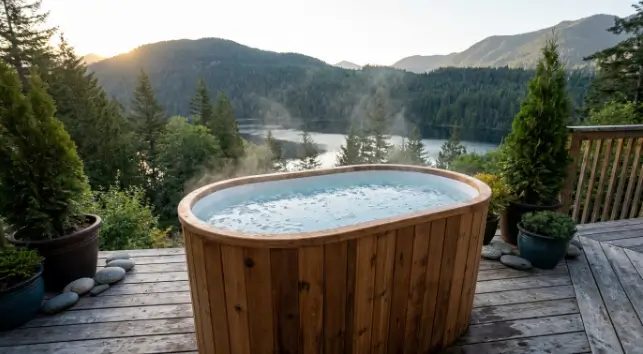

Owning a cold plunge in a small space comes down to four practical questions: where it will sit, how it will be powered, how the water will stay clean, and what the realistic evidence supports before expecting specific results. A compact single-person tub with a plug-in chiller can fit into roughly 15 to 25 square feet including clearance, workable in a garage corner, a small yard, or a covered patio for most first-time owners.
Where a First Cold Plunge Actually Fits
A single-person tub with a compact plug-in chiller typically needs a footprint of 15 to 25 square feet once clearance for the chiller and room to step in and out are included, which fits a garage corner, a covered patio, or a modest side yard in most homes. Indoor placement works too, provided there is a floor drain or a waterproof containment tray nearby, since splashing and condensation are a near guarantee over months of regular use, not an occasional inconvenience. Before buying anything, measuring both the final resting spot and the delivery path, including doorways and gates, avoids the common first-time mistake of a tub that fits the patio but not the route to reach it.
What Beginners Get Wrong About Setup
The most common first-time mistake is underestimating chiller clearance, boxing the unit into a tight enclosure for looks and then wondering why it short cycles or struggles to hold temperature. A close second is skipping a level check on the surface underneath, which can lead to a tub that settles unevenly within the first few months of use. A third is assuming any household outlet will do without checking the chiller’s actual amperage draw, which varies enough between models to be worth confirming before, not after, delivery.
The Realistic Weekly Routine
Most beginners settle into two to four sessions a week rather than daily use, enough to build meaningful cold tolerance without turning the routine into a chore. Water changes for a smaller single-person tub typically happen every two to four weeks depending on filtration quality and use frequency, more often than a larger, more heavily filtered unit might need. Skimming debris and checking the filter or ozone system weekly, even briefly, keeps water quality from degrading gradually to the point where a full drain and refill becomes the only fix.
Noise and Neighbors in a Tight Layout
A chiller compressor runs somewhere in the 45 to 60 decibel range, roughly comparable to a running refrigerator, which is quiet in absolute terms but still a constant background hum rather than a one-time sound. In a townhouse, a condo with shared walls, or an apartment balcony close to a neighbor’s window, that hum is worth thinking through before installation, not after a complaint. Placing the chiller as far from a shared wall or a bedroom window as the small footprint allows, even by a couple of feet, tends to make more difference than most people expect.
What Cold-Water Immersion Is Actually Associated With
A 2023 meta-analysis in Frontiers in Physiology looking at cold water immersion after exercise found it associated with improved perceived recovery and reduced fatigue in some contexts, which lines up with why many first-time buyers try it after workouts specifically. A 2012 Cochrane review focused on muscle soreness found some supportive evidence that cold water immersion reduces soreness compared with rest alone, though the certainty of that evidence was limited by small trial sizes and inconsistent methods across the studies included. These are real, if modest, associations worth knowing, not guarantees tied to any specific product or session count.
Where the Evidence Falls Short
A 2025 systematic review and meta-analysis in PLoS One, evaluating cold water immersion’s effects on health and wellbeing more broadly, found the overall evidence modest and inconsistent across the range of outcomes examined. That is a useful check on some of the broader claims made about cold plunging online, since much of what circulates as established fact is closer to a promising but unsettled area of research. A fair beginner’s expectation is improved perceived recovery and a routine some people genuinely enjoy, not a guaranteed physiological outcome.
Budgeting Honestly for a First Year of Ownership
A basic single-person tub with a plug-in chiller commonly runs $2,500 to $4,500 for the unit itself, with electricity adding roughly $15 to $30 a month for a few sessions a week. Filter cartridges or ozone system parts typically add another $30 to $60 every one to two months depending on the system, a recurring cost easy to forget when comparing sticker prices between models. SweatDecks lists chiller wattage and filtration type together on its product pages, making it easier to compare realistic ongoing costs across models rather than just the upfront price.
What to Check Before the First Delivery
Confirming the delivery path, not just the final resting spot, matters more than most first-time buyers expect. A crated tub that clears a front gate but not a narrow side-yard turn, or a stairwell landing that looks wide enough until a dolly is actually in it, is a common and entirely avoidable delay. Measuring doorway widths, gate clearances, and any tight corners along the route, then checking those numbers against the crated dimensions listed by the manufacturer, takes a few minutes and prevents a delivery crew from turning a tub away at the door.
Choosing a First Tub Without Overbuying
For a first tub, a compact single-person model with a modest chiller is usually a better starting point than a large multi-person unit bought on the assumption a household will grow into it. Sizing up later, once the routine is established and actually sticks, is a far smaller expense than downsizing an oversized tub that never gets consistent use in a space too tight to feel comfortable. A modest first purchase also lowers the cost of finding out, within the first season, whether cold plunging is a habit worth keeping at all.
Frequently Asked Questions
How much space does a first cold plunge actually need?
A single-person tub with a plug-in chiller typically needs 15 to 25 square feet including clearance for the chiller and room to step in and out.
How often should a beginner use a cold plunge?
Two to four sessions a week is a common starting routine, enough to build tolerance without turning it into a daily obligation.
Does cold plunging have proven health benefits?
The evidence is mixed. Some studies link it to improved perceived recovery and reduced soreness, but a 2025 review found the broader evidence base modest and inconsistent.
How much does a first cold plunge cost to own per year?
Budget $2,500 to $4,500 upfront for a basic single-person unit, plus roughly $200 to $500 a year in electricity and filter costs.
References
- “Effects of cold-water immersion on health and wellbeing: A systematic review and meta-analysis.” PLoS One, 2025. https://pubmed.ncbi.nlm.nih.gov/39879231/
- “Effects of cold water immersion after exercise on fatigue recovery and exercise performance: meta analysis.” Frontiers in Physiology, 2023. https://pubmed.ncbi.nlm.nih.gov/36744038/
- “Cold-water immersion (cryotherapy) for preventing and treating muscle soreness after exercise.” Cochrane Database of Systematic Reviews, 2012. https://pubmed.ncbi.nlm.nih.gov/22336838/
By Derek Holloway
